-
 Call Now:
8010 552 552
Call Now:
8010 552 552
-
 Whatsapp Now:
8010 552 552
Whatsapp Now:
8010 552 552
-
 Email Me:
[email protected]
Email Me:
[email protected]
Call Now:
8010 552 552
Whatsapp Now:
8010 552 552
Email Me:
[email protected]

Dealing with constant pain near the tailbone? It could be due to a pilonidal sinus that initially appears as a small swelling but gradually turns into a recurring problem. For many patients, it poses great problems when it comes to walking, sitting, and even sleeping.
What begins as a minor infection soon results in purulent discharge, repeated infections and chronic discomfort.
Traditional treatments for pilonidal sinus include surgical intervention that includes excision of the infected tissue, followed by closure of the wounds by stitching. It also had a long recovery period and a higher chance of recurrence.
However, improvements in medical technology have led to the introduction of laser procedures, which offer several benefits for the patients. The method has emerged as a safe and effective alternative to the conventional method and has greatly transformed the way the condition is treated.
If you are still not aware of this modern approach, this blog will explore the benefits of laser surgery for pilonidal sinus and why it is considered the preferred treatment option.
A pilonidal sinus appears as a small cyst that develops near the tailbone, more precisely near the cleft of the buttocks. It usually contains hair, dirt, and debris that penetrate the skin, triggering an infection.
The condition was known as the “Jeep Driver’s disease” because it was prevalent among military jeep drivers during World War II, who often sat for long hours. Prolonged sitting combined with pressure and friction near the tailbone made them susceptible to developing the discharging sinus.
Even today, pilonidal sinus is frequently seen in individuals who sit for extended periods, such as office workers, students and drivers. Other contributing factors include the following.
In the initial stage, individuals do not usually experience any symptoms other than a dimple-like depression on the surface of the tailbone. However, over time, when it gets infected, the condition slowly develops into a cyst or an abscess.
The symptoms include the following.
If you are someone who notices these signs, make sure not to consider it as just a skin irritation to prevent complications such as sepsis, drainage and recurrence.
Before we delve into the advantages of laser surgery for pilonidal sinus, let’s take a look at the features of the conventional procedure.
Traditional treatment for a pilonidal sinus includes open surgical intervention that involves the complete removal of the infected sinus along with the surrounding affected tissue. The procedure was used for decades by surgeons to provide relief to patients who were suffering from severely infected sinuses.
During the procedure, the surgeon makes a large incision to cut open the entire infected tract to remove the sinus, trapped hair and affected tissues. Depending on the case, the wound may be left open to heal naturally (open excision) or closed with stitches (primary closure).
While traditional surgery can be effective in removing the disease, it is associated with several drawbacks, including:
It is because of these limitations that many patients find conventional surgery physically and emotionally draining. As a result, they are opting for laser surgery for pilonidal sinus, which is a minimally invasive technique.
Laser surgery for pilonidal sinus is a modern, minimally invasive outpatient procedure that uses high-energy laser beams to remove the sinus tract from inside. The energy of the laser rays destroys the infected lining and seals the sinus tract, thereby allowing it to heal naturally.
The whole procedure hardly takes 20 minutes to complete, and patients are discharged on the same day.
The key advantages that patients experience from undergoing a laser procedure are as follows.
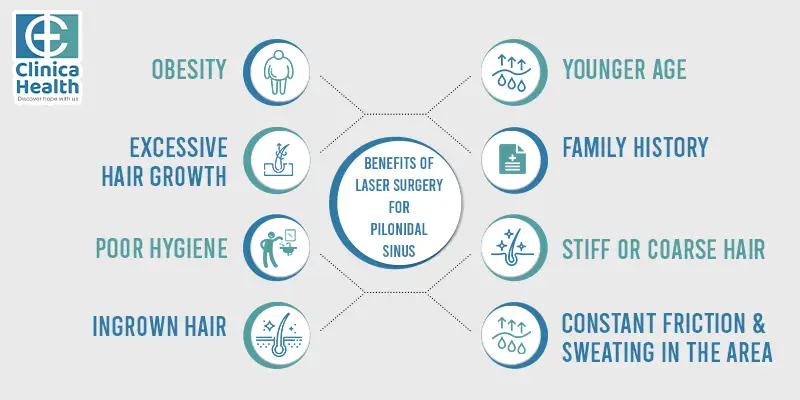
Laser surgery for a pilonidal sinus usually does not have any such major drawbacks. The only disadvantages the procedure involves are as follows:
Dr. Purnendu Bhowmik is a trained and experienced surgeon who specialises in the diagnosis and treatment of pilonidal sinus using minimally invasive techniques.
He is appreciated by patients for his high success rate in conducting laser-based treatments for various conditions. His approach is patient-focused, which ensures thorough examination, personalised treatment planning and compassionate care for the patients.
Dr Bhowmik even accepts all types of medical insurance to make advanced treatments accessible and convenient for all of his patients.
Living with a pilonidal sinus can really be frustrating; however, modern treatments have made recovery from the condition quite easier. With laser surgery for pilonidal sinus from a surgeon like Dr. Purnendu Bhowmik, patients can expect better outcomes and a permanent solution to the disease.

Qualifications:
MBBS(Hons), MS(Surgery), FACS(USA), MRCS (Edinburgh), MRCPS (Glasgow), FMAS(Minimal Access Surgery), FALS(Colo-rectal surgery), FIAGES(Gastrointestinal Endo surgery), FAIS CC Laser proctology (Poland), CC Laparoscopic Hernia Surgery, Advanced Laparoscopy, GI & GI Onco and Laser surgeon