-
 Call Now:
8010 552 552
Call Now:
8010 552 552
-
 Whatsapp Now:
8010 552 552
Whatsapp Now:
8010 552 552
-
 Email Me:
[email protected]
Email Me:
[email protected]
Call Now:
8010 552 552
Whatsapp Now:
8010 552 552
Email Me:
[email protected]

Do you feel like the food refuses to pass down your throat? Or, there is always a sensation that something is choked in the chest, causing discomfort, pressure and even regurgitation. This is the daily struggle of patients living with achalasia cardia.
Swallowing difficulty caused by achalasia cardia is not just an occasional inconvenience. It is a daily struggle that affects the eating habits of the individuals, sleep quality and overall well-being.
Although achalasia cardia treatment, including the medications and procedures, is important for managing the condition, lifestyle strategies are also essential for relieving symptoms. One of the effective yet overlooked approaches is maintaining the right posture and adopting proper sleeping positions at night.
The small changes in the way you sit and sleep make a difference in how food passes into the stomach and even ensure everyday comfort.
In this blog, we will discuss simple posture adjustments and sleeping positions to help individuals with achalasia cardia.
Achalasia cardia is a rare and chronic disorder of the esophagus where the lower esophageal sphincter (LES), which is the valve between the esophagus and stomach, fails to relax properly, due to which the food finds it difficult to pass through the stomach.
In healthy individuals, the esophagus makes wave-like contractions called peristalsis. For patients with achalasia cardia, the muscle becomes weak or absent. As a result, food and liquids have difficulty moving from the esophagus into the stomach.
Dr. Purnendu Bhowmik, a renowned surgeon for offering achalasia cardia treatment, lists the following symptoms that patients usually experience.
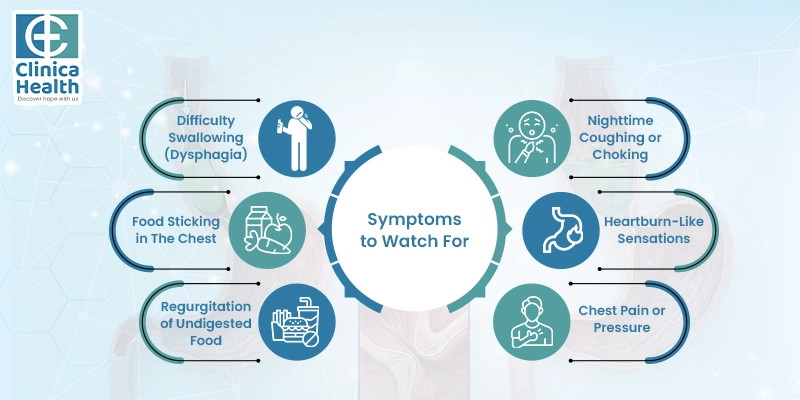
As the food remains in the esophagus for a long duration, proper body posture is definitely required to assist in the movement of food. That’s why, along with achalasia cardia treatment, posture adjustment and sleeping positions are recommended to improve symptom control.
For people with achalasia cardia, the sitting posture while eating matters because gravity helps food move down the esophagus as the lower esophageal sphincter does not relax properly, and peristalsis is weak.
Here are some of the most effective eating postures and habits:
Always make sure to sit with your back straight and shoulders relaxed so that your head remains aligned with the spine. Avoid leaning forward or slouching over the plate, as it can compress the abdomen and esophagus, which can slow down the movement of food and even impair digestion.
Keep your chin slightly elevated, as it can help open the esophageal pathway. If required, take a sip of warm water. This position reduces the risk of food getting stuck and allows smooth swallowing while decreasing regurgitation.
Posture works when combined with good eating patterns to reduce strain on the esophagus. Before eating, cut the food into small pieces and chew thoroughly until it becomes soft. Smaller bites require less effort to swallow and reduce the chance of food getting choked. If needed, drink sips of water after each bite.
Dr. Purnendu Bhowmik advises patients to sit for at least 15 minutes or 30 minutes. Avoid lying down immediately to prevent choking and coughing, which usually occurs when food flows back. You can also go for gentle walking and standing to help encourage food movement towards the stomach.
Dr. Purnendu Bhowmik, a leading surgeon for achalasia cardia treatment, also suggests adopting proper sleeping positions to prevent the flow back of food into the esophagus at night.
One of the recommended strategies is to sleep with the upper body slightly elevated. You can raise your head and chest by about 6 to 8 inches to create a gentle incline that helps gravity drain retained food and saliva from the esophagus into the stomach, preventing nocturnal reflux and aspiration.
Avoid stacking multiple pillows to raise the head, as this might bend the neck and increase abdominal pressure. Instead, it is recommended to use a foam wedge pillow or sturdy bed risers to elevate the entire upper body and support the entire torso.
Lying on the left side is beneficial for managing the symptoms of achalasia. This position reduces the likelihood of regurgitation due to the natural anatomy of the stomach, which helps the food to pass more easily. The left-side position also improves nighttime comfort and minimises acid exposure.
Timing is equally important, just as position is, when it comes to managing achalasia cardia. Lying down right after a meal increases the chances of regurgitation. Dr. Bhowmik recommends waiting for at least 1 to 2 hours after eating before going to bed. This allows more time for food to move downward through the esophagus.
Achalasia cardia treatment works best when combined with proper posture, sleeping techniques and lifestyle modifications.
Though sleeping positions and posture help, the necessity of specialised treatments can’t be ignored. Here are the 5 treatment modalities that Dr. Purnendu Bhowmik usually suggests.
With the right medical care and strategies combined with achalasia cardia treatment, patients can get relief from the symptoms and lead an enhanced quality of life.

Qualifications:
MBBS(Hons), MS(Surgery), FACS(USA), MRCS (Edinburgh), MRCPS (Glasgow), FMAS(Minimal Access Surgery), FALS(Colo-rectal surgery), FIAGES(Gastrointestinal Endo surgery), FAIS CC Laser proctology (Poland), CC Laparoscopic Hernia Surgery, Advanced Laparoscopy, GI & GI Onco and Laser surgeon