-
 Call Now:
8010 552 552
Call Now:
8010 552 552
-
 Whatsapp Now:
8010 552 552
Whatsapp Now:
8010 552 552
-
 Email Me:
[email protected]
Email Me:
[email protected]
Call Now:
8010 552 552
Whatsapp Now:
8010 552 552
Email Me:
[email protected]

It often begins quietly, like changes in bowel habits, unexplained fatigue and persistent abdominal discomfort. These symptoms might seem normal in the early stages, but when they persist and do not improve with medications, they signify something far more serious.
For many patients, these signs indicate colorectal cancer, a life-threatening condition that needs to be addressed promptly. One of the effective treatments for colorectal cancer is colectomy, a surgical procedure that forms the backbone of modern colorectal cancer surgery.
In this blog, we will talk about the procedure involved and the differences between its two types, i.e., partial and total colectomy.
The colon is an important organ of the body that plays a vital role in how our body uses the food that we eat. However, when abnormal cells start to grow in the organ and take the form of cancer, removing the damaged section of the colon becomes extremely important to stop the spread of the malignant cells to the nearby lymph nodes and organs.
Dr. Purnendu Bhowmik, an expert in treating colorectal cancer surgery, usually recommends colectomy as part of colorectal cancer surgery, but at times, the procedure is also suggested to treat other conditions, including the following.
During colectomy, the surgeon removes part or all of the colon (large intestine), depending on the stage of the colon cancer. The procedure can be performed using open, laparoscopic, or robotic techniques.
After removing the affected portion, the surgeon reconnects the healthy sections of the intestine or, in some cases, creates a temporary or permanent colostomy to allow waste to exit the body.
Depending on how much the cancer cells have affected the colon, Dr. Purnendu Bhowmik employs the following approaches: partial colectomy and total colectomy.
In a partial colectomy, only the affected portion of the colon is removed. If required, the procedure also involves excision of the margin of healthy tissue along with nearby lymph nodes. After removing the diseased segment, the surgeon reconnects the remaining healthy parts of the colon, which is known as 'anastomosis', thereby restoring bowel function.
Partial colectomy is carried out for Stage 1 or localised colorectal cancer. In simpler terms, it means removing the affected part of the colon where there is the growth of the tumour while preserving the rest to allow the digestive system to function as normal.
Having performed multiple colorectal cancer surgeries, Dr. Purnendu Bhowmik highlights the benefits of partial colectomy.
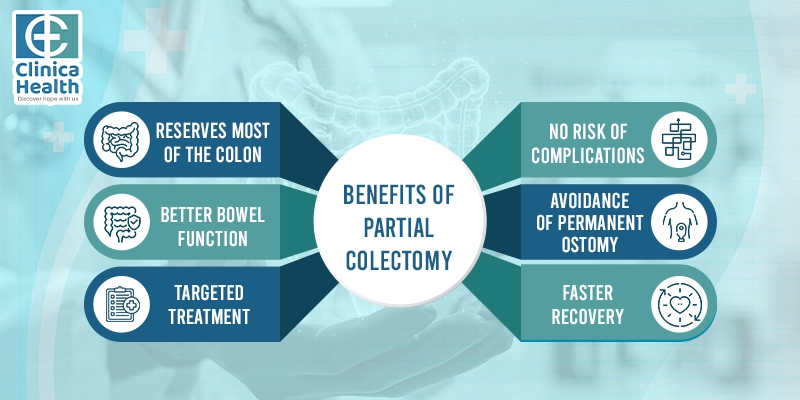
Unlike a partial colectomy, a total colectomy, as a part of colorectal cancer surgery, involves the removal of the entire colon (large intestine), with or without the rectum, followed by creating a permanent stoma. Dr. Purnendu Bhowmik usually recommends this approach when the cancer cells start affecting multiple areas of the colon or when the tumour has largely spread within the bowel.
During the procedure, the surgeon removes the entire colon along with nearby lymph nodes to prevent the spread of cancer. Once it is done, the digestive tract is reconstructed.
For some patients, the small intestine is directly connected to the rectum, allowing waste to pass through the body normally. Whereas for others, a permanent stoma (an opening in the abdomen) is created, and waste is collected in an external bag, known as an ileostomy.
Total colectomy is typically performed under the following scenarios.
Here are the advantages of total colectomy as a part of colorectal cancer surgery.
If you or a loved one is experiencing persistent digestive symptoms, seek early medical advice from Dr. Purnendu Bhowmik, a leading expert in colorectal cancer surgery.
He will determine whether you need a partial or total colectomy to remove diseased tissue and prevent the cancer from progressing to the advanced stage.

Qualifications:
MBBS(Hons), MS(Surgery), FACS(USA), MRCS (Edinburgh), MRCPS (Glasgow), FMAS(Minimal Access Surgery), FALS(Colo-rectal surgery), FIAGES(Gastrointestinal Endo surgery), FAIS CC Laser proctology (Poland), CC Laparoscopic Hernia Surgery, Advanced Laparoscopy, GI & GI Onco and Laser surgeon