-
 Call Now:
8010 552 552
Call Now:
8010 552 552
-
 Whatsapp Now:
8010 552 552
Whatsapp Now:
8010 552 552
-
 Email Me:
[email protected]
Email Me:
[email protected]
Call Now:
8010 552 552
Whatsapp Now:
8010 552 552
Email Me:
[email protected]

Rectal prolapse not only comes with discomfort but also embarrassment and frustration. It is a condition where the rectum slips out of its original position. For most patients, surgery is the long-term solution, especially when conservative methods like diet modifications, bowel diet changes or pelvic floor exercises fail to provide relief from the symptoms.
However, even after undergoing recurrence, it is the thought of recurrence that raises concerns among patients. They only wonder, "Can the condition come back in the future?”
In this blog, Dr. Purnendu Bhowmik, a leading expert specialising in rectal prolapse surgery, provides insights on why recurrence happens, what the factors are that influence it, and ways to minimise its risk.
Rectal prolapse occurs when the rectum, that is the final portion of the large intestine, protrudes through the anus. The condition varies in severity, from partial slipping, where a part of the mucosal lining slips out, to full-thickness prolapse, in which the entire wall of the rectum protrudes. The condition is more common in women than in men, though it can affect both genders equally under certain conditions.
Sometimes rectal prolapse is misdiagnosed and confused with haemorrhoids because both conditions involve tissue protruding from the anus. However, the major difference is that rectal prolapse is caused by the slipping of the final attachments of the large intestine. On the other hand, haemorrhoids are enlarged blood vessels that form in the lower rectum and anus.
Rectal prolapse progresses gradually, and its symptoms vary from mild discomfort to severe complications, says Dr. Purnendu Bhowmik.
Having performed thousands of complex rectal prolapse surgeries, Dr. Bhowmik lists the signs that most patients likely experience.
In the initial days, patients might find that the prolapse only occurs during bowel movements and eventually retracts on its own. But as the condition progresses, the rectum may remain outside the anus and require manual repositioning.
In the majority of cases, rectal prolapse surgery is the only definitive treatment for rectal prolapse. The goal of surgical intervention is to restore the rectum to its normal position and strengthen the surrounding tissues.
Dr. Purnendu Bhowmik employs the common techniques, which are as follows:
Rectal prolapse surgery is effective, but there is still a possibility of recurrence depending on the surgical technique and adherence to postoperative instructions, according to Dr. Purnendu Bhowmik.
Abdominal procedures, such as rectopexy, have a significantly lower rate of recurrence. Moreover, this surgical technique can be carried out in both laparoscopic and robotic approaches, which further reduces this risk.
On the other hand, perineal procedures like the Altemeier or Delorme approaches might see a high recurrence rate due to the less extensive reinforcement of the rectum.
Hence, Dr. Bhowmik always performs abdominal repair for rectal prolapse in younger and healthier patients.
Additionally, certain factors increase the chance of rectal prolapse surgery, such as chronic constipation, straining during bowel movements, weak pelvic floor muscles, obesity and neurological conditions.
Recurrence of rectal prolapse can occur within months or years. Early recurrence suggests incomplete or inadequate repairs, whereas late recurrence may result from progressive tissue weakening or ongoing risk factors.
As already mentioned, rectal prolapse recurs primarily not only because of surgical failure but also due to risk factors that make a patient more susceptible to recurrence.
Though no surgery can indeed guarantee permanent relief from the condition, certain measures after rectal prolapse surgery can comparatively reduce the risk.
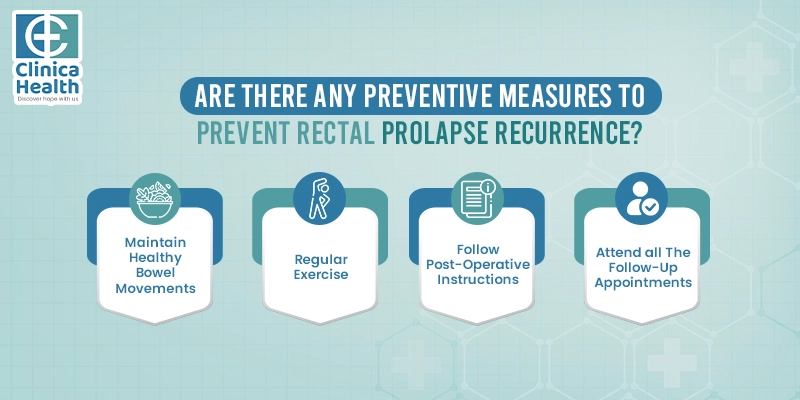
The possibility of recurrence after rectal prolapse surgery can happen, but it is not impossible to avoid. With the right surgical technique by a surgeon like Dr. Purnendu Bhowmik and proper post-operative care, patients can experience significant improvement in life. Adhering to preventive strategies provides long-lasting and effective relief and restores bowel function for patients.
Qualifications:
MBBS(Hons), MS(Surgery), FACS(USA), MRCS (Edinburgh), MRCPS (Glasgow), FMAS(Minimal Access Surgery), FALS(Colo-rectal surgery), FIAGES(Gastrointestinal Endo surgery), FAIS CC Laser proctology (Poland), CC Laparoscopic Hernia Surgery, Advanced Laparoscopy, GI & GI Onco and Laser surgeon