-
 Call Now:
8010 552 552
-
 Whatsapp Now:
8010 552 552
-
 Email Me:
[email protected]
Call Now:
8010 552 552
Whatsapp Now:
8010 552 552
Email Me:
[email protected]

Many people develop twisted, bulging veins on their legs but still ignore the condition. They assume that those swollen veins are just minor skin inconveniences and will eventually fade with a cream, over-the-counter supplements or just a few weeks of rest.
At times, patients even hear that surgical intervention is the only possible solution. Varicose veins are a common vascular condition that leads to uncomfortable symptoms which ultimately interfere with both the comfort and daily activities of individuals.
Some people present with mild symptoms, whereas others experience constant aching, leg heaviness, skin changes and other complications that require a doctor’s advice.
Not every individual with varicose veins requires surgery. In some cases, conventional treatment options like lifestyle changes, compression stockings, and physical changes help with managing the symptoms.
But most patients wonder if it is possible for varicose veins to heal on their own completely without the need to have a medical operation. Today, many patients are treated with minimally invasive options like laser procedures that take hardly 30 minutes to an hour to complete.
In this blog, we will delve into what works for varicose veins, what does not, and when it is necessary to consult a varicose vein surgeon in Kolkata, like Dr. Purnendu Bhowmik.
No, it is not possible for varicose veins to completely heal and disappear on their own without seeking a surgeon’s advice. Certain medications and conservative approaches can relieve symptoms, but they do not offer a complete cure.
Whenever individuals consult the best varicose vein surgeon in Kolkata, Dr. Purnendu Bhowmik, patients are mostly advised to use medical compression stockings to enhance blood flow, leg raises, exercises to strengthen the core muscles and weight control, especially if the individual is in the first stage of the condition.
In some patients, plant-based diosmin-based drugs such as venoactive and vasoprotective medications are also prescribed to reduce swelling, pain and cramping. However, all of these can provide temporary relief.
However, none of them is actually effective at repairing a failed or weakened valve to shrink the veins permanently.
Moreover, there is no strong evidence that compression stockings provide relief from active varicose veins or venous ulcers. So, once the vein is damaged, traditional approaches only slow down but cannot rebuild the valve.
The majority of patients with varicose veins are at risk of developing venous ulcers when left unaddressed. However, not every individual is likely to suffer from severe complications. Dr. Purnendu Bhowmik, a top varicose vein surgeon in Kolkata, urges patients not to ignore the signs to prevent worsening of the condition.
What are the treatment options available for varicose veins?
The treatment of varicose veins has come a long way, from the old open method to minimally invasive options. Endovenous laser treatment involves small incisions, a shorter hospital stay and weeks of recovery.
Endovenous laser treatment is one of the most widely used modern treatments for varicose veins, preferred by both surgeons and patients.
Here is how the procedure works, as followed by a varicose vein surgeon in Kolkata.
For decades, open surgery for varicose veins was the standard treatment and is still regarded as the main procedure to manage serious venous complications.
However, conventional surgery is less commonly performed because endovenous options are less invasive, but it remains a popular choice among patients.
Most of the varicose vein surgeon in Kolkata usually adopt the two methods when it comes to the traditional method.
Ligation: A small incision is made behind the knee to locate the faulty vein. The surgeon ties off and then divides the vein where it joins the deep system to stop the blood from flowing backwards into the leg.
Stripping: Here, a thin and flexible wire is passed through the diseased vein, which is then removed through the incision using the stripping wire. Many surgeons keep the stripping to the knee to reduce the risk of nerve injury.
Open varicose vein surgeries are typically performed under sedation and take around 60 minutes to complete. It also comes with several drawbacks compared to minimally invasive methods.
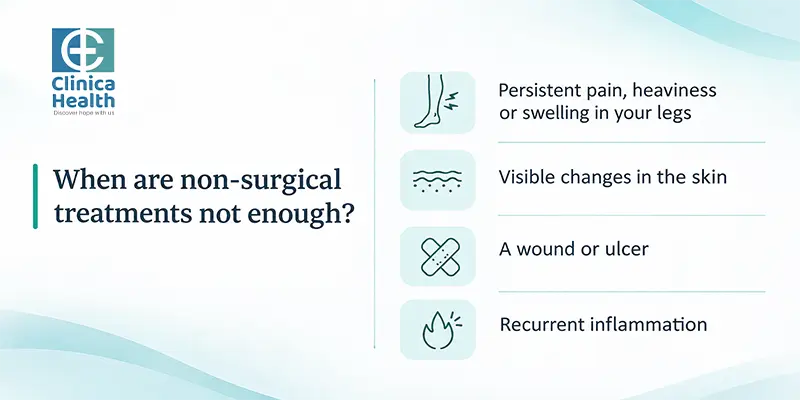
Dr. Purnendu Bhowmik recommends Endovenous laser treatment (EVLT) as the first-line treatment. That said, Dr. Bhowmik points out that open surgery has not become obsolete.
Here is a quick comparison between the two treatment methods.
|
Features |
Laser surgery |
Open surgery |
|
Incisions |
A small needle-like puncture involving no large cuts and stitches. |
Multiple incisions, and hence there are cuts and wounds |
|
Blood loss |
No heavy bleeding |
Blood loss |
|
Procedure time |
15 to 30 minutes |
One hour or more |
|
Hospital stay |
Same-day discharge |
Longer hospital stay |
|
Recovery period |
Quick return to normal activities. |
Bruising and tenderness; recovery takes weeks. |
|
Scar formation |
No visible scarring |
Ugly scars at the incision site |
|
Chances of infection |
Minimal chances |
Higher probability |
|
Recurrence rate |
Low or almost negligible |
Higher recurrence |
|
Best suited for |
When other methods are not suitable |
Most patients with confirmed varicose veins. |
The main goal of varicose vein treatment is to prevent the backward flow of blood in the diseased vein. Make sure to book an appointment with Dr. Purnendu Bhowmik, the best varicose vein surgeon in Kolkata, who will assess your veins and perform the least invasive and most effective method that will work for you.
Qualifications:
MBBS(Hons), MS(Surgery), FACS(USA), MRCS (Edinburgh), MRCPS (Glasgow), FMAS(Minimal Access Surgery), FALS(Colo-rectal surgery), FIAGES(Gastrointestinal Endo surgery), FAIS CC Laser proctology (Poland), CC Laparoscopic Hernia Surgery, Advanced Laparoscopy, GI & GI Onco and Laser surgeon