Silent Vs. Symptomatic Gallstones: Why Some People In Kolkata Live With Stones For Years Without Knowing
Gallstones are one of the most common digestive disorders, yet a large population remains undiagnosed. Most patients only seek medical treatment whenever they develop sudden and painful attacks that begin to disrupt their daily activities.
For many individuals, gallstones remain silent for years and are only discovered during routine checkups and unrelated medical scans. So, the question is, why do gallstones behave differently from one person to another?
Let’s know the answer from Dr Purnendu Bhowmik, the best gallbladder surgeon in Kolkata.
What Are Gallstones?
Gallstones are hardened pebble-like deposits that form in the gallbladder. They are formed when the substances in bile, such as cholesterol or bilirubin, become imbalanced and begin to crystallise.
Gallstones greatly vary in size and number. Some individuals can have a single stone, whereas others can have multiple stones. The size can range from tiny grains of sand to as large as a golf ball.
The main causes of gallbladder stones are linked to poor diet, unhealthy lifestyle choices and genetic factors. The condition is typically present in individuals with symptoms or without symptoms that remain undetected for years.
Silent Gallstones: An Overview
Silent gallstones, often known as asymptomatic gallstones, do not cause any noticeable or troublesome signs. Most of the individuals with gallbladder stones fall into this category and are accidentally discovered during abdominal imaging tests, such as an ultrasound for other conditions, or while going for routine checkups.
Silent gallstones usually do not cause any harm. This is because they are located deep within the gallbladder, without blocking the bile duct or irritating the gallbladder wall. Hence, the gallbladder contracts naturally without resulting in inflammation or infection.
Moreover, in some patients, the stones remain the same size and dissolve over time. Due to the lack of movement of the gallbladder stones, the body usually does not notice them. However, in the majority of cases, these stones lead to complications in the future.
Who Is At Risk?
Silent gallstones are mostly present in individuals under the following categories.
- Women after pregnancy
- Older adults or middle-aged individuals
- Individuals with a sedentary lifestyle
- Those with underlying medical conditions like diabetes and obesity
- Patients with mild cholesterol imbalance
- The ones with a high intake of calories and unhealthy fats
What Are Symptomatic Gallstones?
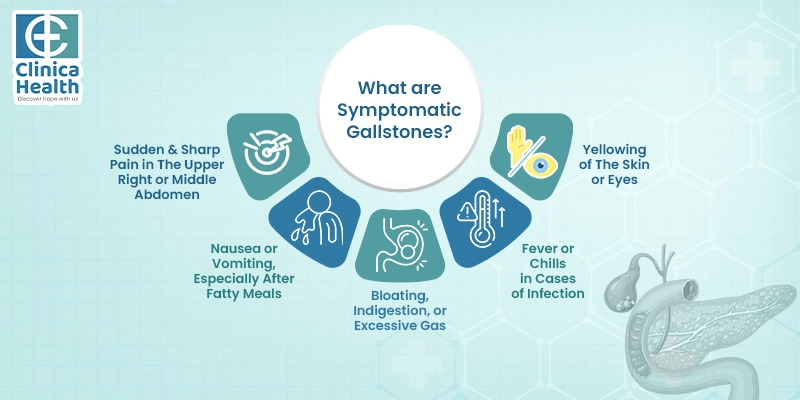
Symptomatic gallstones are the ones that trigger inflammation or obstruction in the gallbladder, which eventually leads to uncomfortable or painful symptoms. This usually happens when a stone blocks the bile flow, which irritates the gallbladder lining.
According to Dr. Purnendu Bhowmik, the best gallbladder surgeon in Kolkata, individuals with an asymptomatic gallbladder often experience the following signs.
- Sudden and sharp pain in the upper right or middle abdomen that radiates to the back or right shoulder.
- Nausea or vomiting, especially after fatty meals
- Bloating, indigestion, or excessive gas
- Fever or chills in cases of infection
- Yellowing of the skin or eyes (jaundice) in severe or complicated cases
Remember that symptomatic gallstones do not go away on their own. They need urgent medical attention and, in most cases, surgical intervention to prevent complications.
Why Is There A Sudden Rise In Gallstones?
There has been a sudden increase in the prevalence of both silent and asymptomatic gallstones. Most of the gallbladder surgeons in Kolkata state the following reasons.
- Changes in the eating pattern: One of the biggest contributors to the eating habits of individuals. Home-cooked meals are getting replaced by packaged meals, fried items and sugary beverages. Too much consumption of high-fat foods increases the cholesterol level in the bile, due to which it becomes oversaturated and hardens to form gallstones.
- Reduced physical activity: Today, most individuals are required to sit for long hours at work. Lack of physical activity for a long time affects the ability of the bile to empty itself. When the gallbladder fails to move properly, it leads to stagnation of the bile and eventually stone formation.
- Hormonal factors: Dr. Purnendu Bhowmik, the best gallbladder surgeon in Kolkata, states that there has been a steady rise in the presence of gallstones among the female population. Hormonal changes, particularly estrogen, increase the risk of cholesterol in the bile, which is a primary reason behind gallstone formation.
- Delayed medical attention: Most of us ignore the signs of gallbladder stones as a minor inconvenience. Mild abdominal discomfort, along with bloating, nausea and vomiting, especially after eating fatty meals, is frequently mistaken for acidity or indigestion. What begins as an occasional pain eventually turns into gallbladder pain, which progresses slowly and needs urgent attention.
- Genetic predisposition: Individuals with a family history of gallstones are susceptible to developing the condition. Genetic factors, when combined with unhealthy lifestyle choices, multiply the risk.
Risk Of Ignoring Gallstones
Silent symptoms can suddenly become asymptomatic. When left untreated for a long time, it can pose serious complications like the following.
- Acute cholecystitis (inflammation of the gallbladder).
- Obstructive jaundice (blockage of bile flow).
- Pancreatitis (inflammation of the pancreas).
- Emergency surgery, which carries higher risks than a planned procedure
Treatment Options
The most effective treatment for the gallbladder is surgical intervention. It involves the removal of the gallbladder as a way to provide a long-term solution for gallstones.
As the best gallbladder surgeon in Kolkata, Dr. Purnendu Bhowmik employs the following surgical approaches.
- Open method: Here, the surgeon makes large incisions, and it is mainly recommended when issues like severe scarring, inflammation and anatomical complications arise.
- Laparoscopic procedure: It is a minimally invasive procedure done through small incisions. It is the most preferred method and offers faster healing, minimal pain and shorter hospital stays.
Conclusion
Living with gallstones without symptoms is more common than most people realise. However, once symptoms appear, they rarely go away permanently without treatment. Hence, if you notice any changes in your digestive health, seek expert advice from Dr. Purnendu Bhowmik, the best gallbladder surgeon in Kolkata, for early evaluation and treatment.
 Call Now:
7595 838 844
8010 552 552
Call Now:
7595 838 844
8010 552 552
 Whatsapp Now:
8010 552 552
Whatsapp Now:
8010 552 552
 Email Me:
[email protected]
Email Me:
[email protected]
