-
 Call Now:
8010 552 552
Call Now:
8010 552 552
-
 Whatsapp Now:
8010 552 552
Whatsapp Now:
8010 552 552
-
 Email Me:
[email protected]
Email Me:
[email protected]
Call Now:
8010 552 552
Whatsapp Now:
8010 552 552
Email Me:
[email protected]

Hearing that you need “colon cancer surgery” can frighten anyone. From removal of the tumour to the recovery period, these are the worries that go through the minds of patients and make the treatment journey quite overwhelming.
Modern colon cancer surgery has greatly improved over the years and has become personalised. Not every patient undergoes the same operation, and the surgical approach also depends on several factors, including the location and size of the tumour, cancer stage, involvement of nearby lymph nodes, whether the cancer has spread, and the patient's overall health.
Still, some questions linger, like, “What does the operation look like?”, “How is the tumour removed?”, “Will the surgeon need to excise a part of the colon or the entire colon?” and “What can patients expect during the recovery period?”
This blog will help you walk through these answers to turn your fear of going under the knife into a smooth experience.
Surgery is the primary treatment for almost all stages of colon cancer. The procedure involves removing all or part of the cancerous tumour and some portions of the healthy tissue, along with the nearby lymph nodes in case of metastasis. For most colon cancers, especially stages 1 through 3, surgery offers the best chance of a cure with improved survival chances.
Once the malignant colon is removed, the remaining sections of the bowel are joined together so that normal bowel function can continue.
The procedure is often called a colectomy, and it is of the following types.
Colon cancer surgery can be performed through the open method, laparoscopic approach or robotic-assisted technique, based on what the surgeon feels is right.
Here is a step-by-step guide to what patients can expect during colon cancer surgery, depending on the tumour stage.
Stage 0 Colon Cancer: Also known as carcinoma in situ, where the cancerous cells are confined to the innermost lining of the colon. Patients at this stage do not usually need extensive surgery. Most of the time, the growth can be completely removed by colonoscopy. However, if the lesion is large or has the characteristics of invasive cancer, surgical intervention is the best option.
Stage I Colon Cancer: At this stage, the malignant cells have spread beyond the innermost lining to the nearby lymph nodes or the colon wall but have not reached the lymph nodes or distant organs. Here, the colorectal surgeon identifies the section of the colon containing the tumour and performs a partial colectomy to remove that segment along with a small margin of healthy tissue and lymph nodes. The two healthy ends of the bowel are then reconnected, known as anastomosis.
Stage II Colon Cancer: By the time a patient reaches Stage 2, the cancerous cells have already penetrated deeper through the wall of the colon and may have reached nearby tissues, but it has not spread to regional lymph nodes or distant organs. The basic colon cancer surgery approach remains the same as in Stage 1.
The only difference is that your surgeon will remove a wider margin of surrounding tissue since the tumour has extended beyond the colon wall. The surgeon might also excise a few lymph nodes to find out if they have a higher risk of recurrence, where chemotherapy is considered to prevent them from multiplying.
Stage III Colon Cancer: This is the point where the cancer has spread to one or more regional lymph nodes but has not established distant metastases. Surgery remains the primary treatment but is often combined with two or more other treatments. The surgeon not only removes the primary tumour but also a margin and the full lymphatic drainage basin, along with the lymph nodes, as in earlier stages, to ensure as much diseased tissue as possible is cleared.
After that, the two healthy ends of the colon are reconnected to restore the passage of waste through the digestive tract. In some situations, a surgeon might create a stoma, which can be either temporary or permanent, to allow the stool to leave the body into an external bag. The lymph nodes increase the risk of cancer returning back and hence adjuvant chemotherapy is almost always recommended to kill the invisible and microscopic cancer cells that remain in the body after a successful surgery.
Stage IV Colon Cancer: Here, the cancer has spread beyond the colon to distant organs, more specifically the liver and lungs. Surgical intervention depends on the severity of the spread. If there are only a small number of metastases that are surgically accessible, the surgeon will perform both a colon cancer surgery to remove the primary tumour and a resection of the metastatic tissue, sometimes in the same operation and sometimes in stages. Patients are also given chemotherapy before or after surgery to shrink tumours and control disease elsewhere in the body.
However, in cases where the spread is too far, the goal shifts from cure to managing the symptoms. This might involve palliative surgery, which is done to relieve blockage in the colon, or the placement of a stent to keep the bowel open. It allows the patient to eat and pass waste more comfortably while systemic treatments like chemotherapy or targeted therapy work to control the cancer's growth.
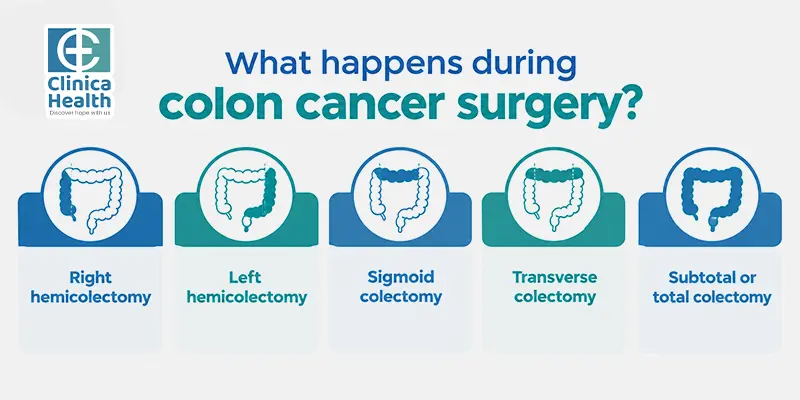
The stage of the colon cancer plays an important role in determining how the surgery will look. The main aim of treatment is to remove as many cancerous cells as safely as possible while giving patients the best chances of recovery.
The right treatment plan always begins with consulting an experienced surgeon like Dr. Purnendu Bhowmik, who has years of experience in performing colon cancer surgery, to build a surgical approach tailored specifically to the diagnosis of patients.

Qualifications:
MBBS(Hons), MS(Surgery), FACS(USA), MRCS (Edinburgh), MRCPS (Glasgow), FMAS(Minimal Access Surgery), FALS(Colo-rectal surgery), FIAGES(Gastrointestinal Endo surgery), FAIS CC Laser proctology (Poland), CC Laparoscopic Hernia Surgery, Advanced Laparoscopy, GI & GI Onco and Laser surgeon