-
 Call Now:
8010 552 552
Call Now:
8010 552 552
-
 Whatsapp Now:
8010 552 552
Whatsapp Now:
8010 552 552
-
 Email Me:
[email protected]
Email Me:
[email protected]
Call Now:
8010 552 552
Whatsapp Now:
8010 552 552
Email Me:
[email protected]

Achalasia cardia is a rare but chronic disorder of the esophagus where the lower sphincter muscles fail to relax properly, and normal peristalsis is lost. This prevents food and liquids from passing into the stomach, and patients always feel that something is choked inside the throat.
Individuals with achalasia cardia also suffer from various uncomfortable symptoms such as difficulty in swallowing, regurgitation of undigested food, chest pain, malnutrition and even weight loss. When left untreated for a long time, the condition leaves a severe and long-lasting impact on the patients.
The management of this condition has significantly evolved over the years. Traditional treatment approaches included medications like calcium channel blockers and nitrates to relax the LES. Though they are effective, the results were short-lived.
Today, the disorder is mostly treated with Heller Myotomy, which has emerged as the long-term achalasia cardia surgical treatment.
In this blog, Dr. Purnendu Bhowmik, a specialist with experience in providing relief from achalasia cardia, discusses why Heller Myotomy gained popularity over medications for long-term management.
The esophagus is a muscular, tube-like structure that connects the mouth to the stomach. It is responsible for transporting food after swallowing. The movement is achieved through coordinated wave-like muscle contractions called peristalsis, which gently push the food downward in a controlled manner. At the lower end of the esophagus lies the lower esophageal sphincter (LES), a circular muscle that normally remains closed to prevent stomach contents from flowing backwards. During swallowing, the LES temporarily relaxes, allowing food and liquids to pass into the stomach before closing again to maintain one-way movement.
However, in patients with achalasia cardia, the LES fails to relax properly during swallowing, preventing food and liquids from passing easily into the stomach. Moreover, the normal peristaltic movements of the esophagus are either absent or severely impaired. As a result, food accumulates in the esophagus, leading to symptoms.
Dr. Purnendu Bhowmik lists the following symptoms which indicate the need for undergoing achalasia cardia surgical treatment.
If you are someone who has been experiencing these symptoms for a long time, make sure to get yourself evaluated. Unaddressed achalasia cardia leads to complications such as aspiration pneumonia and an increased risk of esophageal cancer.
Medicines are often prescribed as the first line of achalasia cardia treatment, especially in early and mild cases. Dr. Purnendu Bhowmik usually prescribes calcium channel blockers and nitrates.
They temporarily reduce the pressure on the LES, thereby making swallowing a lot easier. However, as stated, the results are short-lived and come with side effects like headaches, dizziness, low blood pressure and fatigue.
Moreover, the medicines do not actually fix the actual cause of dysphagia, and hence, patients continue to experience dysphagia. Over time, the body responds less effectively to these drugs.
Dr. Purnendu Bhowmik usually considers medication therapy as a temporary measure, particularly for those who are unfit for achalasia cardia surgical treatment.
The most widely used and popular surgical treatment for achalasia cardia is the Heller myotomy procedure. It is a minimally invasive procedure performed using laparoscopic techniques that involves smaller incisions.
During the operation, the surgeon cuts the muscles of the lower esophageal sphincter and, if necessary, a small portion of the esophagus. This, in turn, relieves the excessive pressure caused by the non-relaxing sphincter, allowing food and liquids to pass more easily into the stomach.
The procedure is often combined with an anti-reflux procedure called fundoplication. In most cases, surgeons perform a partial fundoplication, which helps prevent gastroesophageal reflux while preserving normal swallowing. The choice of fundoplication depends on the patient's condition and the surgeon's clinical assessment.
When performed by an experienced surgeon, Heller myotomy is the standard procedure for achalasia cardia surgical treatment. It has a high success rate and is most preferred by surgeons due to its improved morbidity and quicker recovery time.
Dr. Purnendu Bhowmik, known for his expertise in achalasia cardia surgical treatment, provides a comparison between medicines and Heller myotomy.
Effectiveness
Suitable Candidates
Duration of Relief
Recovery time
Side effects and risks
The decision whether to go for medicines and Heller myotomy depends on several factors, such as severity of achalasia, age, overall health, and individual treatment goals.
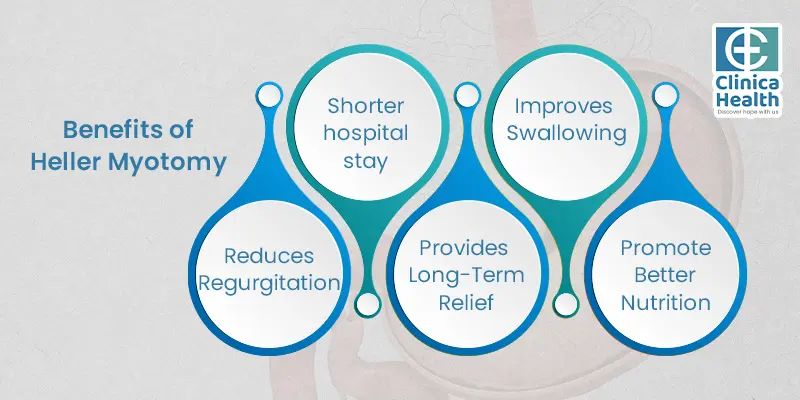
Dr. Purnendu Bhowmik states the advantages of Heller Myotomy as the best achalasia cardia surgical treatment over conventional methods.
Achalasia cardia is a serious condition that requires temporary symptom relief. With a high success rate and faster recovery period, Heller myotomy is the best achalasia cardia surgical treatment. However, make sure to get in touch with Dr. Purnendu Bhowmik, who will assess your symptoms and determine the accurate diagnosis and the most accurate treatment options.

Qualifications:
MBBS(Hons), MS(Surgery), FACS(USA), MRCS (Edinburgh), MRCPS (Glasgow), FMAS(Minimal Access Surgery), FALS(Colo-rectal surgery), FIAGES(Gastrointestinal Endo surgery), FAIS CC Laser proctology (Poland), CC Laparoscopic Hernia Surgery, Advanced Laparoscopy, GI & GI Onco and Laser surgeon