-
 Call Now:
8010 552 552
Call Now:
8010 552 552
-
 Whatsapp Now:
8010 552 552
Whatsapp Now:
8010 552 552
-
 Email Me:
[email protected]
Email Me:
[email protected]
Call Now:
8010 552 552
Whatsapp Now:
8010 552 552
Email Me:
[email protected]

You have a bulge that becomes more uncomfortable every time you strain on the toilet. For people living with rectal prolapse, the condition is not an occasional inconvenience. When the rectum slips and protrudes through the stomach, everyday activities like walking, sitting, coughing, and bowel movements feel stressful.
For many individuals, rectal prolapse causes symptoms like constipation, bleeding, itching, incomplete evacuation and loss of bowel control.
Rectal prolapse surgery is the most effective treatment and has come a long way, with a high success rate and, in many cases, a normal return to life.
If you or a loved one is having rectal prolapse and has been recommended surgery as the next step, here is what you actually need to know, from its procedure details to recovery time and success rates.
Rectal prolapse occurs when part of the rectum (the last part of the large intestine) slips from its original position and protrudes through the anus.
It mostly happens when the muscles and surrounding tissues that normally hold the rectum in place get weakened and lose their attachment, causing it to slide out through the anal orifice and turn inside out.
There are generally three types of prolapse.
Complete Prolapse: Here, the entire wall of the rectum protrudes out of the anus.
Mucosal Prolapse: This is where only the inner lining of the rectum slides out.
Internal Prolapse: The rectum begins to descend without visibly protruding outside the body.
Though internal prolapse can sometimes be managed with non-surgical treatments, complete prolapse always needs to be treated with surgery for a permanent solution.
Whenever someone notices a bulge, some discomfort or maybe a bit of bleeding during bowel movement, the first thing is probably "haemorrhoids" or piles.
Haemorrhoids affect a large number of individuals irrespective of age and gender. But what if all types of bulges around the anus are not haemorrhoids at all?
Rectal prolapse can look like haemorrhoids on the surface, but it is a completely different condition. When diagnosed and treated with haemorrhoid creams and left untreated, it tends to get worse rather than better.
Haemorrhoids are swollen, inflamed blood vessels located in the lowest part of the rectum and anus. It even become enlarged due to chronic straining, pregnancy and constipation.
On the other hand, rectal prolapse is a condition where the rectum itself loses its normal support and slips downward, at times, protruding entirely through the anus.
Both conditions occur in the same genital area and cause the same symptoms; hence, they are misdiagnosed and inappropriately treated.
Rectal prolapse surgery is the most effective treatment for the condition. However, there is not a single surgical intervention. Dr. Purnendu Bhowmik, a leading rectal prolapse surgeon, chooses from several approaches after examining the patient's age, health and severity of prolapse.
Here are the common types.
They are typically suggested for younger and healthier patients because they have lower recurrence rates. The procedure involves making an opening in the abdominal muscles to examine and perform the operation on the abdominal cavity.
It can be performed through traditional open surgery or minimally invasive laparoscopic or robotic techniques. Abdominal rectal prolapse repair is carried out in two ways.
Rectopexy: Here, it involves repositioning the rectum back to its original place and securing it to the sacrum using sutures and mesh.
Resection: The method involves combining rectopexy with removal of an elongated segment of the sigmoid colon and then repositioning and securing the rectum to the sacrum.
They are mainly reserved for older patients or individuals with certain health issues. Here, the surgeon removes the prolapsed rectum and reconnects the remaining bowel. The procedure is carried out like the following.
Altemeier: The section of the rectum protruding out of the anus is removed, and the two healthy ends are reconnected.
Delorme: Only the inner surface of the prolapsed rectum is removed, and the underlying muscle layer is folded and stitched to reinforce the area, without removing bowel tissue.
The success rate of rectal prolapse surgery depends on the condition of the tissues and the patient’s age and health. When compared to perineal procedures, abdominal rectal prolapse surgery has a lower chance of recurrence.
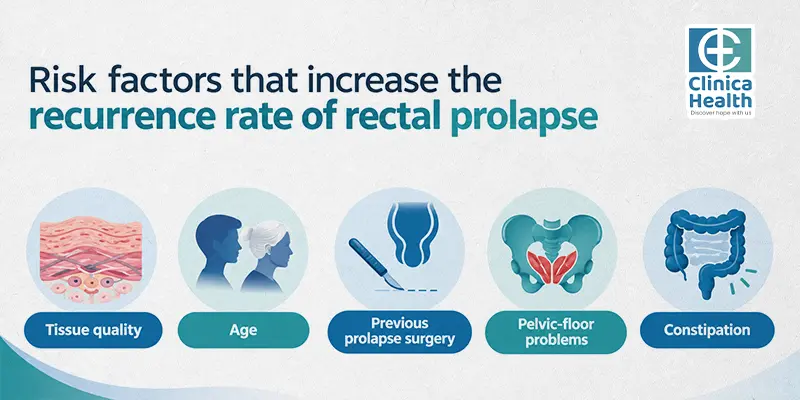
Even if rectal prolapse comes back, it is likely around 10 per cent after several years of follow-up. The prolapsed rectum improves with surgical intervention, but its recurrence rate depends on the following factors.
Tissue Quality: Weaker and more stretched tissues are prone to recurrence.
Age: Younger individuals heal quickly after abdominal repair as compared with older or fragile adults who should go for a perineal procedure.
Previous Prolapse Surgery: A history of previous repair can increase the risk of recurrence.
Pelvic-Floor Problems: Weakness and dysfunction of the pelvic floor muscles can again contribute to rectal prolapse.
Constipation: Chronic constipation and repeated straining put stress on the repair and may increase the risk of recurrence.
The recovery after rectal prolapse surgery depends on the type of procedure and adherence to the doctor’s instructions.
If the procedure is done through laparoscopic technique, patients generally experience less pain and may return to light daily activities within a few days to 1–2 weeks. However, for the open method, they might be required to stay a few days in the hospital, and the recovery time is also longer.
Once home, individuals can experience mild discomfort, fatigue, and some abdominal bloating. These are completely normal and resolve with medicines. Your doctor will prescribe stool softeners to prevent straining, which could put stress on the surgical repair.
Moreover, light walking is encouraged, but lifting, bending, and strenuous activity should be avoided.
If you need to undergo rectal prolapse surgery, make sure to have an open conversation with a qualified healthcare professional to know which procedure suits your condition and what recovery looks like.
If you are experiencing symptoms of rectal prolapse or want to discuss your concerns, reach out to Dr. Purnendu Bhowmik for a consultation.

Qualifications:
MBBS(Hons), MS(Surgery), FACS(USA), MRCS (Edinburgh), MRCPS (Glasgow), FMAS(Minimal Access Surgery), FALS(Colo-rectal surgery), FIAGES(Gastrointestinal Endo surgery), FAIS CC Laser proctology (Poland), CC Laparoscopic Hernia Surgery, Advanced Laparoscopy, GI & GI Onco and Laser surgeon