-
 Call Now:
8010 552 552
-
 Whatsapp Now:
8010 552 552
-
 Email Me:
[email protected]
Call Now:
8010 552 552
Whatsapp Now:
8010 552 552
Email Me:
[email protected]

Changes in bowel movements accompanied by persistent abdominal discomfort, unexplained weight loss, and blood in the stool are symptoms that must not be considered mere digestive issues.
Most of these issues usually point to common digestive concerns such as gas, acidity, stomach pain and constipation. However, in some cases, these signs even point to colon or rectal cancer.
Colon and rectal cancer are usually grouped and known as “colorectal cancer.” This is because they share similar symptoms and many other features. However, they develop at different parts of the large intestine, which determines how the tumour behaves and presents with different symptoms. Even the treatment approach is not the same, and surgeons may suggest colon cancer surgery, chemotherapy or radiation therapy.
According to the World Health Organisation's International Agency for Research on Cancer (IARC), approximately 1.93 million new colorectal cancer cases were reported worldwide in 2022. The high incidence rate makes colorectal cancer the third most commonly diagnosed cancer globally and the second leading cause of death.
These figures highlight the necessity of being aware of and recognising potential warning signs and understanding the available treatment options.
The large intestine has two major parts. The colon is the longer, upper section, about 1.5 metres, where water is absorbed from digested food. The rectum is the last 12 to 15 cm, which stores stool before it leaves through the anus.
Cancer in either part usually develops as a small growth known as a polyp on the inner lining, which is generally benign. However, over time, they turn into malignant cells and prove to be life-threatening.
Rectal cancer is located deep in the narrow pelvis near the bladder, prostate or uterus, and the nerves controlling bladder, bowel and sexual function. So, the treatment is to remove the cancer cells while preserving these organs.
The prevalence of colorectal cancer in India is low as compared to Western countries. However, it is still a major health concern affecting quite a large number of individuals.
In India, colorectal cancer is the fourth most common cancer both among men and women. As per reports in 2022, 64,863 new cases have been reported, with 38,367 deaths.
Previously, colorectal cancer was considered the disease of the old. But now, even younger people are getting affected. According to reports, a quarter to a third of colorectal cancers are found in people under 40, often at an advanced stage (III or IV).
The primary reason behind the decreasing survival rate after both rectal and colon cancer surgery is late diagnosis. Warning signs like rectal bleeding, abdominal pain or a change in bowel habits are often ignored as piles or acidity. Hence, by the time the disease gets diagnosed during screening, it may have spread, and treatment becomes complicated. When it is caught early, treatment works much better.
If you notice prolonged changes in your bowel movements as well as rectal bleeding, don’t wait for them to worsen. Book an appointment with Dr. Purnendu Bhowmik, a leading colon and rectal cancer surgeon in Kolkata, for early assessment and proper check-up.
Colon and rectal cancer usually share warning signs, and the terms are used interchangeably; the condition is known as colorectal cancer. What’s more striking is that in the early stage, the individual experiences no symptoms at all.
But because the colon and rectum are in different parts of the bowel, there are slight differences in how the symptoms appear.
Let’s take a look at the signs that indicate you might need colon cancer surgery.
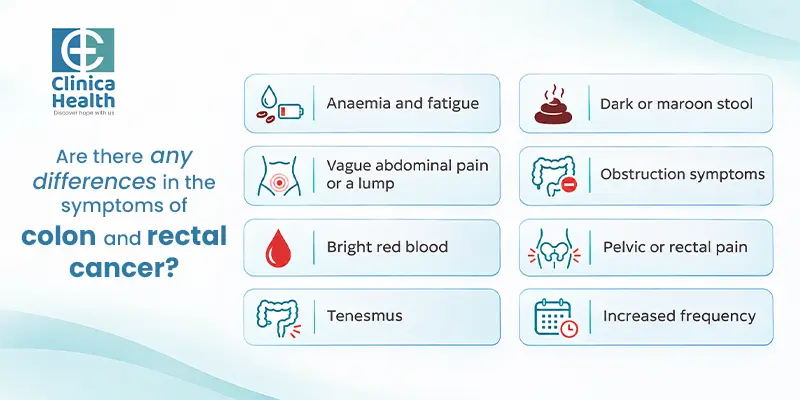
Anaemia and Fatigue: Tumours on the right side of the colon often bleed slowly. So the stool looks normal, while the individual experiences unintentional weight loss, due to which they appear pale and weak.
Dark or Maroon Stool: Bleeding within the colon causes stools to appear dark red or maroon because the blood has travelled a long way through the bowel.
Vague Abdominal Pain or a Lump: Tumours on the right side of the colon grow large in size before resulting in a blockage. Hence, some individuals experience persistent abdominal pain.
Obstruction Symptoms: Tumours on the left side of the colon may cause constipation, abdominal swelling, cramping and difficulty passing stool or gas that requires medical attention.
Most of the time, rectal cancer is mistaken for piles, due to which individuals delay treatment for months. Here are the symptoms that call for urgent consultation with the surgeon.
Bright Red Blood: It usually coats the stool, which is easily mistaken for piles
Tenesmus: There is always a feeling that you still need to pass stool even after you have completed bowel movements.
Pelvic or rectal pain. Individuals may even experience fullness and pressure in the rectum.
Increased Frequency: There is an urge to have small bowel movements.
For colon cancer, surgery is the primary treatment. Colon cancer surgery involves removing the portion of the intestine containing the malignant cells along with a margin of healthy tissue and then reconnecting the two ends.
The procedure is called a colectomy, and it is of the following types
Today, colon cancer surgery is frequently done laparoscopically (keyhole) or with robotic assistance, which means smaller incisions, less pain, shorter hospital stays and faster recovery.
Rectal cancer is more complex, and treatment aims to protect the sphincter, bladder and sexual function.
Surgery remains the standard approach and involves removing the rectum along with its surrounding fatty tissue and lymph nodes. Options include the following
Low anterior resection (removing the tumour and reconnecting the bowel)
Abdominoperineal resection (when the tumour is too close to the anus to preserve the sphincter)
Total mesorectal excision (removal of the rectum together with its surrounding fatty envelope, blood vessels, and lymph nodes).
In some patients, the surgeon creates a temporary ileostomy to protect the new joins while it heals, which is then reversed after a few months.
Based on the reports, chemotherapy is usually advised for high-risk cases either after rectal or colon cancer surgery.
Both rectal and colon cancer are closely related but not the same. What is important is early detection for an improved outcome.
If you or a loved one is worried about abdominal pain or bowel movements, expert advice can save lives. Dr. Purnendu Bhowmik provides thorough evaluation and rectal and colon cancer surgery in Kolkata, with a treatment plan tailored to each patient.

Qualifications:
MBBS(Hons), MS(Surgery), FACS(USA), MRCS (Edinburgh), MRCPS (Glasgow), FMAS(Minimal Access Surgery), FALS(Colo-rectal surgery), FIAGES(Gastrointestinal Endo surgery), FAIS CC Laser proctology (Poland), CC Laparoscopic Hernia Surgery, Advanced Laparoscopy, GI & GI Onco and Laser surgeon