-
 Call Now:
8010 552 552
Call Now:
8010 552 552
-
 Whatsapp Now:
8010 552 552
Whatsapp Now:
8010 552 552
-
 Email Me:
[email protected]
Email Me:
[email protected]
Call Now:
8010 552 552
Whatsapp Now:
8010 552 552
Email Me:
[email protected]

A pilonidal sinus usually begins as a small opening near the tailbone, but when it becomes infected or repeatedly inflamed, it can turn into a painful and frustrating condition.
It keeps coming back no matter how often it gets drained. For any individual who has pilonidal sinus, symptoms like pain, swelling, purulent discharge and recurring infections feel like an endless cycle.
Moreover, the idea of going under the knife also comes with a new worry related to whether the procedure actually works and when you can get back on your feet to lead a healthy life.
For years, traditional surgery was the only treatment for pilonidal sinus. However, over the years, laser surgery for pilonidal sinus emerged as a new technique offering several advantages over the open method.
Conventional treatment for pilonidal sinus came with drawbacks that made minimally invasive techniques popular and changed how many patients approach treatment.
So how do the two really compare? This blog gives a detailed breakdown to help you understand your options.
A pilonidal sinus is a small tunnel or cavity that forms in the skin, usually at the top of the buttocks near the tailbone. It often develops when loose hair burrows into the skin, triggering inflammation, infection, and the formation of a cyst or abscess. Left untreated, it can become chronic, causing recurring pain, drainage, and infections that significantly affect daily life.
In the initial stage, some people really do not experience symptoms at all. However, others do encounter pain, swelling, discharge or bleeding.
Pilonidal sinus usually does not heal on its own; acute flare-ups can sometimes be managed with antibiotics, but laser surgery for pilonidal sinus is typically required to remove the sinus tract and prevent recurrence.
Traditional surgical treatment has been the standard approach and involves excising the affected tissue. The common types are:
Wide excision with open healing: During the procedure, the sinus tract and surrounding affected tissue are surgically removed, and the wound is left open to heal gradually from the inside out.
Excision with primary closure: The tissue is removed, and the wound is stitched closed immediately, which can heal faster but carries a higher risk of wound breakdown or infection.
Flap procedures: The technique is an advanced reconstruction technique and is mostly recommended for severe cases, and the approach involves reshaping the skin and tissue around the area to flatten the natal cleft, which reduces the risk of recurrence.
Pros of Traditional Surgery
Conventional surgical intervention for pilonidal sinus comes with certain drawbacks. Here are some of them.
Laser treatment for pilonidal sinus is a newer, modern and minimally invasive option that has gained popularity for its promise of a faster, less painful recovery and several benefits compared to the open method.
The procedure is known as Sinus Laser Closure (SiLaC) and is mainly recommended to patients who prefer reduced tissue damage, less postoperative discomfort and a quicker return to their daily activities.
The procedure starts with cleaning the sinus tract to remove hair, debris and infected material from the sinus tract. During the procedure, a thin laser fibre with high-energy beams is inserted into the sinus tract through its opening.
The laser energy destroys the lining of the tract from the inside, causing it to collapse and seal shut, without the need for a large external incision, preserving the healthy tissues.
Unlike traditional surgery, where large incisions are made to remove the sinus, the wound is much smaller in the laser procedure, and hence the recovery period is much faster.
Advantages of laser surgery for pilonidal sinus
Are there any cons?
Despite so many advantages, laser surgery for pilonidal sinus also has cons.
If you are suffering from a pilonidal sinus, make sure to consult an experienced surgeon like Dr. Purnendu Bhowmik, who will assess your condition and suggest the appropriate treatment choices based on the following.
Severity and Complexity of the Sinus: If you have single-tract sinuses, a laser procedure is the ideal choice with excellent outcomes. However, complex, branched, or recurrent sinuses may need traditional excision or flap surgery.
Desired Recovery Speed: For patients like working professionals or students who are required to get back to work or daily life quickly, Dr. Bhowmik prefers the laser procedure because of its shorter downtime.
Scarring Concerns: Laser surgery typically leaves a much smaller mark, which matters to many patients who are worried about cosmetic results.
History of Recurrence: Patients who have had the condition come back after previous surgery may benefit more from a flap procedure designed specifically to reduce recurrence risk.
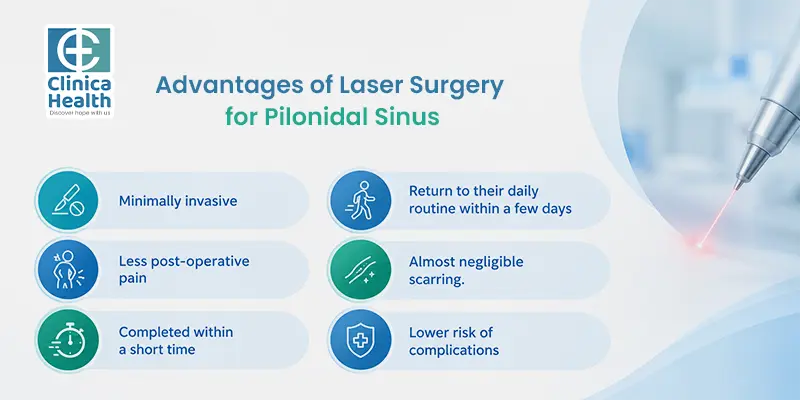
Both laser and traditional procedures are effective for pilonidal sinus but serve different purposes. Laser surgery for pilonidal sinus represents an important minimally invasive option offering less pain, minimal scarring, and a much faster return to daily life compared to traditional excision.
The most important step is to consult a qualified doctor like Dr. Purnendu Bhowmik, who is experienced in both techniques and can explain the right option suitable for your needs.

Qualifications:
MBBS(Hons), MS(Surgery), FACS(USA), MRCS (Edinburgh), MRCPS (Glasgow), FMAS(Minimal Access Surgery), FALS(Colo-rectal surgery), FIAGES(Gastrointestinal Endo surgery), FAIS CC Laser proctology (Poland), CC Laparoscopic Hernia Surgery, Advanced Laparoscopy, GI & GI Onco and Laser surgeon